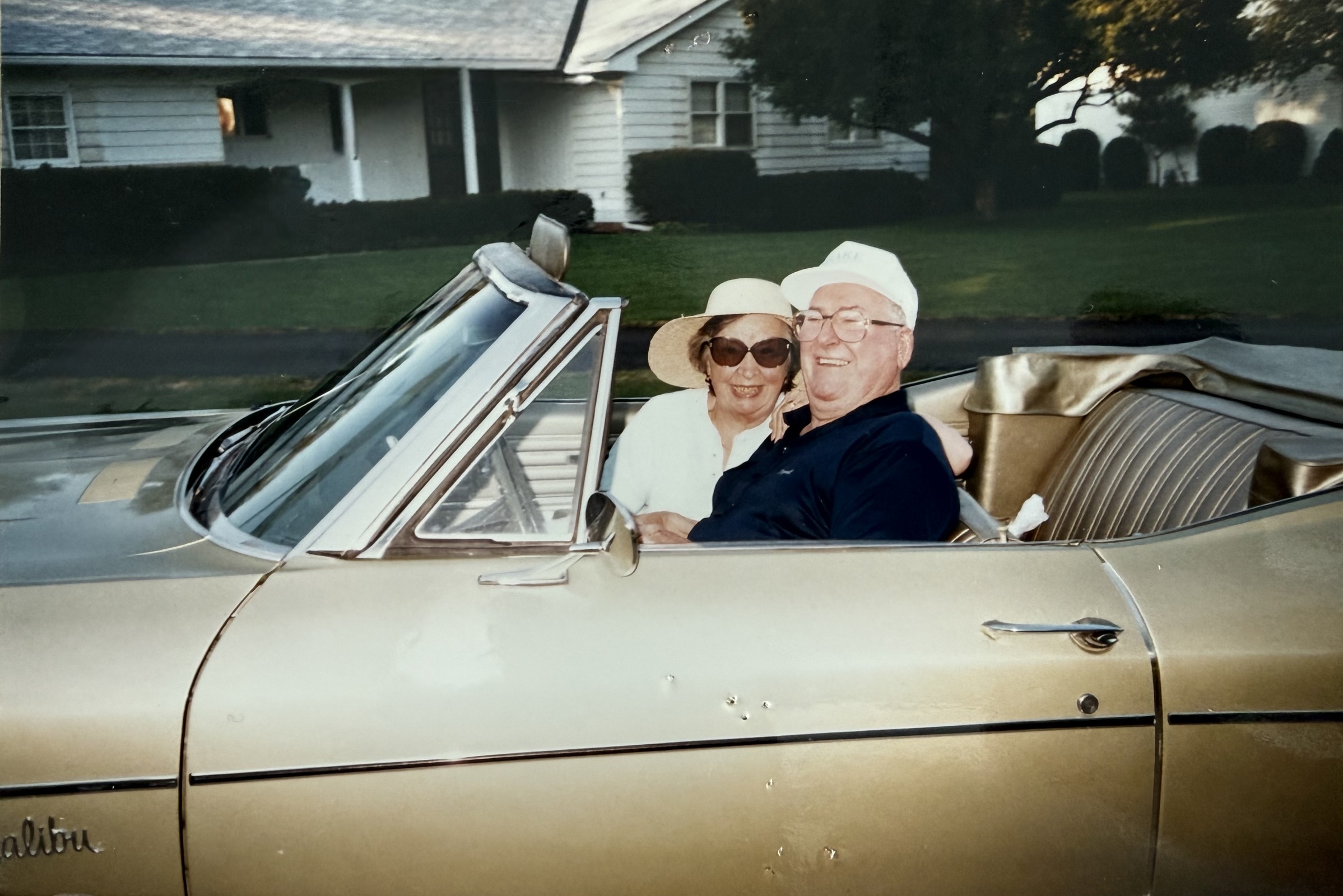
Gene & Betty
In his own words
Watch Gino
Pull up a chair.
Let Grandpa Gene tell the story.
Read the full transcript
Speaker 1 You And That was unfortunately the same damn weekend He sent me all the things. Your family's in there. Your children, your birthdates, his birthdate.
This guy done a ton of research work. Of course, he called me in the phone one day. He must have talked an hour to me in the phone.
In the middle of the day, too. And that's a lot of money for Dallas, Texas. And I gave him all the dope I could give him over the phone.
Everybody in there, he has... Like, I see... Grandma, my grandmother.
that's my dad's mother was born and Alexis Illinois and my grandfather Patrick Conroy Oh PW was born in South Boston in 1850 1850 yeah which your grandfather it was my grandfather yeah do you know where his parents were born hey Barton you know where his parents were born his parents his dad his dad was born in this country mother born in Ireland but my hit my so your great great grandfather's born in this country in Boston yeah and the American matter of fact uncle see uncle Tom cut my great uncle Tom he was a Civil War veteran on a Boston regiment up there in Boston I don't fact I think some of the some of the relatives are I think well oh grandpa Conroy's will grab a cowboy grandfather I think he was a revolutionary war he was probably he was uh my and my and uh now my my grandmother was born in elections in illinois and uh she was born i think about 18 18 18 58 or somewhere in there but i don't want when my dad was alive we went down elections about oh maybe 40 or 50 miles south and west of galesburg illinois I had some customers in Galesburg. So we went down and I took my dad with me. And we rode down to Alexis.
And we went in this town of Monmouth, Illinois. I talked to this fellow, one of the customers. He was one of our distributors.
I told my dad his daughter. He said he's part of the Shannick family. He said, Shannick.
He said, there's a guy. I know real Wilbur. He runs a tavern down the street.
So he went down to see my dad's cousin, Wilbur Schunick.
Speaker 3 There he was.
Speaker 1 There he was.
Speaker 3 How do you spell that?
Speaker 1 S-C-H-U-N-I-C-K.
Speaker 3 Schunick.
Speaker 1 Schunick. His Irish name is Schunick. I'll hear it.
So anyway, we found out, and he said his mother was still alive, and that was my dad's aunt. So we went down, I think I want to, I don't think it was her name. Anyway, we went down to see this old lady.
And my gosh, she's all, why don't she go out and look, she'll go out to the cemetery and see mom and dad's grave. That was my dad's grandfather and grandmother. Your dad's?
They were buried in the cemetery. Your dad's grandfather. So we went out there.
That's my great-great-grandfather, see. And we went out there in the cemetery, and old, old, old, old, his name was Edmund, Edmund Shunick. He was born in 1813.
And he died in 1903. He was over 100 years old, he died. I remember he was in a, I was in a tombstone there, in Bonnet, down in Lexus, Illinois.
My dad, you know, my dad, he was so, it was unbelievable. And we went back to Cousin Edgar, and I'd tell the rest. I'd get together.
And Ted, Cousin Edgar, and Edgar, Cousin Edgar, and Edgar, well, his father name was Edgar, but he called him Edgar. Anyway, Cousin Edgar, he'd be my second cousin, my dad's first cousin. That way he had to do the tavern.
There's a good time.
Speaker 3 So Shunnick was on your father's mother's side?
Speaker 1 My mother's name was Mary Shunnick. Oh, okay. And my grandfather...
Where did Gordon come from? Well, Gordon was my mother's son of the family. Gordon was my mother, see.
Was her maiden name Gordon or Shunnick? No, my mother's maiden name was Gordon.
Speaker 3 Shunnick is his father's mother's name.
Speaker 1 My father's mother's name.
Speaker 3 Yeah.
Speaker 1 My grandma, her name was Mary Shunnick. And she, well, Grandpa Conroy, old P.W., he died in Chicago in 1936. He was 89 years old, and he passed away in Chicago.
Now, Grandma Conroy died, oh, gosh, she was too old. She had a breast cancer, I remember, because I was a little boy. And they were living in Chicago at that time.
And my dad and I went up there and was, oh, gosh, I don't know, maybe it was 10 years old. Maybe maybe 1922 or three she passed away and she wasn't that old. Oh, she was in her 60s But I mean she was she was Grandpa grandpa was he died in 86. He was 86 86 1800 1850 so he's like 1936 For your grandfather. Yeah, yeah, I've taken my grandfather right your your your great-grandfather there's a PW Patrick William yeah Chicago he died did he die at the Chicago is he the one to Chicago Athletic Club no that was up to Morris uncle Mike that's his brother no that was his son that was my uncle okay let's get this organized get away with the Gordon my father my Patrick and Patrick and Mary Conroy, that's my grandmother, they had ten children.
They had eight boys and two girls. They had Bob was the oldest. Ed was the second.
Tom was the third. My dad was the fourth. Then they had Aunt Mary.
And then they had Aunt Mary. And then they had Uncle Francis. He's called Pete.
Uncle Francis. that Aunt Nan and Uncle Dave and Uncle Dick and Uncle Morris, he was called him Mike, and Morris was the Amos family. Morris was born in 1898.
He was the Amos family. Uncle Dick was 20 years old when I was born. Uncle Dick, he was born in 1894.
My dad told me, Grandpa Conroy took my dad and his two other brothers to the World's Fair in Chicago, 1894 World's Fair. And that's the year Uncle Dick was born. And, matter of fact, Uncle Dick, we used to care about that.
Uncle Dick was, he was 20 years old when I was born. And he was quite a character, Uncle Richard. Oh, they all were characters, let's put it that way.
Uncle Bob, Uncle Bob's oldest son. Uncle Bob's had two boys. And you met one of his boys playing golf.
young Bob Conroy, remember? Yeah. He went up to the golf course.
Did he really? Yeah. But his youngest son was killed in Normandy Beach in D-Day.
He was only 18 years old. It was John. It was John Conroy, yeah.
John, he was killed in Normandy Beach. 18 years old.
Speaker 3 Did they live in Chicago?
Speaker 1 Yeah, they lived in Chicago. Uncle Bob lived in Chicago. I mean, but your grandparents. See what happened now. My grandfather was a boiler maker by trade.
Speaker 3 That's P.W.
Speaker 1 Yeah. And his wife married. He went out to Galesburg, Illinois, or out to Kewanee, Illinois.
From Boston? He went to work for the Kewanee Motor Company. And my grandmother came up to visit her sister who lived in Galesburg, Illinois, and they went to the church social, those days, the church social.
And they got married. And my Uncle Bob, Uncle Tom, Uncle Ed, and my dad, was he? Uncle Ed, Tom, yeah.
Four of them were born in Kewaddy, Illinois.
Speaker 3 Okay.
Speaker 1 My dad was born in Kewaddy because when my dad applied for Social Security, I got his birth certificate down in Kewaddy with the church over there and got his birth certificate. He was baptized in the church in Kewaddy, Illinois. And there, my grandfather then moved to Bloomingdale.
I went to work for the old Chevalman Outer Railroad Company as a boilermaker. And that's where the rest of them. They lived at 1308 North Oak Street.
The old home is still there.
Speaker 3 Yeah, we saw that.
Speaker 1 Must be 150 years old now.
Speaker 3 And that was P.W. and Mary and their ten children.
Speaker 1 Yeah. And then when Aunt Mary, that was her oldest daughter, she had a real position. She was a secretary to the superintendent of the railroad.
And they were transferred. He was always transferred to Chicago. And she went along with him.
Then Graham and Grandpa went to Chicago with her. She was single at that time. And they got an apartment in the 4450 South County, by the way, so it's in my head.
Of course, it's all black there now, but it was nice to never notice. They're right by Washington Park in South Chicago there. I remember my grandmother took me down to the old White City and had a big amusement park in the old White City.
60s are in Cottage Grove Avenue. I forget that. That was a long time ago.
And then, And when they, see, then Grandma died. All the rest of them left in the way. My Aunt Mary married a fellow man of Walter Dacre.
He was a city electrician. He was electrician. Anyway, they bought a house on Beverly Hills.
It was a very nice area out there. And they had, oh, they had about four or five children,
Speaker 3 I guess and my grandpa lived with them so that he went he went from Boston to Galesburg to Bloomington and back to Chicago
Speaker 1 We went to Boston to Kiwannee I did not Gales but Kiwannee And Bloomington back to Chicago He died in Chicago He was grandma Conroy was a big tall guy good-looking guy But he was a little white-haired guy old scully high But he was 83 years old he swam around now this is this is the truth Tell her she's a swimmer. She swam around in the Navy, Perrin, Chicago, 83 years old. That old guy, he kept on a blue, but we were kids.
He loved this. He kept on a blue, but at that time, I was just, oh, God, maybe 15 years old, 14 or 15. And Grandpa come down a blue, and we went out to build a park.
And Grandpa had to be in his early 70s then. And I remember we rented a Bane suit for him at the park. And he was putting the suit over the shoe.
He had an apron in the suit. He got a little too big for Grandpa. He was putting toes together.
Bob Murray was a lifeguard. We came out there, and Grandpa had a very nice trim mustache, white mustache. Good-looking guy.
When I was up, he'd take a foot off the down. Jesus Christ. Bummer.
He never came up. He never, ever. I said, well, he went straight out there.
He was 40 yards out. Spit the water in the way out. Spit the water.
Then he took off and went across the lake. The lake was about to cross it. He sat up there while he swam back.
Popper said, where the hell did that guy come from?
Speaker 3 And he swam around the hill.
Speaker 1 Then he got up and down. He took a dive off the high tower. Then he done the Cobbler's Act.
He got down under the water. He was pounding on the thing like the Cobbler. He was like, legs were on the pole underneath the diving pier there.
He was pounding on the thing. He's having a helmet.
Speaker 3 And he was in his 70s.
Speaker 1 Oh, in his 70s.
Speaker 3 Oh, God.
Speaker 1 Oh, God. He can swim like a fish.
Speaker 3 Well, 70s when he dived off the high dive. Yeah. Yeah, but 83 when he swam.
Speaker 1 Yeah, but 83 when he swam. He was already ready to go around for a simple pair of five miles. He was raised up there.
He was the oldest guy I've ever done. I think the Book of Records is something. He was quite a guy.
Speaker 3 Is he the guy with, I'm going to let Alex in. Should I let him in?
Speaker 1 Oh, yeah, please. I'm sorry. Anyway. I don't know. how would your mother is back he told you tell this story well even the Boston they
Speaker 2 lived early the Charles River there and this PW yeah yeah so his father was born also in Boston his father born in Boston yeah his mother was born in Ireland mother born in Ireland yeah but you I don't know when his father was born in Boston. I mean, as far as you go, I imagine he'd yet be.
Speaker 1 Let's see. I'd be probably after 1800 and somewhere in there. Matter of fact, I think this guy had him a thing over there.
I think he had him to 18. See, I think he was 25 or 26 when my grandfather was born. I know I got a picture of him.
I'll send it to you. Uncle Tom I fiction grandpa I think Kim's got someone to uncle Tom who was in the Civil War but grab a car right tell us he was cute a boy he said jump off because I was jumping to the sage shower you know right there in Boston the shower shower
Speaker 3 river from the river is he that I was the parent you have to get got the
Speaker 1 retail the very where's your grandfather you brought the pair back
Speaker 3 Pw
Speaker 1 Yeah Still get a few bucks every year That farm
Speaker 3 Yeah, yes he worked on the railroad really
Speaker 1 He worked for the railroad Yeah, he was but he went down on his job in a railroad in Mexico. That's where he that's where he brought back carterita But he was quite he was quite a guy Oh, Grandpa Connery was quite a... I would say, when the old age, he would go on a fiddle for it. He could get moving, he kept going, you know.
Like my mother said, he'd come home and save his loan and get him with his grandmother and the family when I guess he'd leave. Either care, they had him up. Ten kids.
They had ten kids, yeah.
Speaker 3 Was he the one to put shit himself on the pipes, too?
Speaker 1 Yeah, even he had a call. That was a... The whole day, he'd drink this stuff. I probably should pick something myself.
He didn't realize it's about 40% alcohol. Oh, yeah. The only thing you feel great, you know, because I had to call people.
People didn't realize you're supposed to take two tablespoons in the morning, you know, but they do a bad drug. He goes downstairs. And old Grandpa never drank.
He never drank. Why, Grandpa never drank. He never drank.
Old Grandpa, all his... He had two or three sons that were drank, and the rest of them drank like fish. But the rest of them, but Grandpa never drank.
But anyway, he got some of this hatical, and he goes on the baby, started shooting himself in the water, put the pipe up. Flooded a baby. Uncle Walter had come home.
He was going to kill the old man. Oh, that was funny.
Speaker 3 That's when he lived with that.
Speaker 1 Yeah, he lived with that. He had an income. the old man and then come and they probably get paid him to put in rent I don't know but he still had the land other day because he he had he homes entered his land in Oklahoma and Texas one of his places and liberal Kansas and uncle Tom uncle and for I have homes in land in diamond Oklahoma that was they get a free liver you get 200 have a section yeah section 620 acre yeah three or two two hundred two one second second six hundred forty acres of it I think so yeah well he had half a section yeah he and they home said you look you live out of you live on it for a year right it's yours yours yeah well he went out there and back and forth he lived out there I think she lived in one of those but houses that used to be with cats.
I don't know. And Uncle Ed lived there. My uncle Ed stayed out there.
Speaker 3 Stayed in Oklahoma.
Speaker 1 Stayed in Oklahoma and married a woman born there. And they had a child. And she died, she was young, about 19 or 20 years old.
She died of appendicitis. She was a good person. No, someone's wrong to take care of that.
But at those days you couldn't do that. But the land is still out there. Mobile Mobile Oil has the mental rights in the thing.
There's an oil in the lady. I don't want to dribble around, but I don't do. I get a check.
Comes time to hear for a couple hundred bucks.
Speaker 3 From the oil well. From the family land.
Speaker 2 From the family land, yeah. That's going to be passing down to me. It's a legacy. You're never on a legacy.
Speaker 1 You're not a hell of a day. But anyway, it might be going by that time, Bill. I don't know. I'm the oldest living male Conway right now.
Speaker 3 Gene, who in the world was Aunt Minnie?
Speaker 1 Aunt Minnie was my mother's first cousin.
Speaker 3 Oh, okay.
Speaker 1 So that's on the Gordon side.
Speaker 3 That's on the Gordon side. Because that's the one that Darv always talked about. BJ talked about Aunt Minnie.
Speaker 1 Oh, he talked about Aunt Minnie. He always talked about Aunt Clara.
Speaker 2 Oh. Now, Darv was, of course, your brother, half-brother. And my grandfather, your father, was William John.
William James. William James. Oh, James, okay.
I thought I was the son.
Speaker 1 No, you were named after your mother's father was John. So you were named after my father and your mother's father. Two grandfathers, okay. John Conroy, John Wagner was your mother's father. But dad was William James.
Speaker 2 But then B.J.'s, Uncle Darv's brother or mother died when she was young. In childbirth. In childbirth. Yeah, I didn't know.
Speaker 1 So really he was not raised by. No, well, there's another story. My dad, he was born in 1905.
And my dad... Yeah, BJ. And my dad took him home to Bloomington, and Grandma Conroy raised him.
He went to Healy. Same with Grandma Conroy. He went to Chicago with him.
He married you. He married you. He was about 20 years old.
He married some girl in Chicago. And it didn't last. And they got divorced.
And then, I don't know, he got... I think he got... Dooku Drake or something.
Dad, I remember that. Dad brought him home. That was about 19, oh, 25 or so, 24, 25.
Speaker 2 And by this time, you and Bill in June were born?
Speaker 1 Yeah, I was born in 13, and Bill was born in 15, and June was born in 20. So your dad remarried Eleanor Gordon.
Speaker 2 Yeah. Your mother. BJ came back when he was a young man. Yeah, came back to live with us, yeah.
Speaker 3 He was about 20.
Speaker 1 Maybe 21, I think.
Speaker 3 Yeah.
Speaker 1 20 or 21. He looked at us for, well, he married Ruth around, let's see. He wants to marry Ruth about 19, let me think now.
I went to Chicago in 34. Yeah, he married Ruth about maybe 1931 or two. He better my dad was in the hospital and Ruth was a nurse and broke a hospital RN and Well, BJ met around there at the hospital and started going together Oh, they're getting married. They look a little right down the street from us in Bloomington right there We live on the corner of the house with only my catty corner down the street there in Bloomington And then he bought a house out on they bought Build a place out on the floor of Sam and Bloomington moved out there There he went to service Mary what to got a service you want to play Tomahawk and stayed up there for And all by the way I Sit right there down one Fun you know go to one yeah, you know this crap out here and all of a sudden boom
Speaker 2 Good yeah, so don't show it to us
Speaker 3 I'd like to ask him for that baby picture of you. Because if I put up, you know, Molly and I and Sheila and the one of she and John together, then I'd like to put you up too.
Speaker 2 Yeah. Or other pictures. There's a ton of pictures here we can go through. It'd be fun to go through some of those.
Speaker 3 Yeah.
Speaker 1 That's my brother Bill.
Speaker 3 Oh, my gosh.
Speaker 1 That's his graduation picture.
Speaker 3 Was he ever? Yeah, he has a brother Bill.
Speaker 1 That's his graduation picture.
Speaker 3 Whoa, he was a handsome guy.
Speaker 1 Yeah, he was a good old man. Well, we're all good old guys. All the Connery are good old.
Speaker 3 I'd like a picture of you.
Speaker 1 Come here. I'll show you something. I want you to know you.
Come here. You can find me in here. See, you know those people.
Speaker 3 Well, I can picture, I can see Darb right away.
Speaker 1 There's Darb right there.
Speaker 3 That's right. Boy, he hasn't changed a bit.
Speaker 1 That was a good service.
Speaker 3 Is this you back here?
Speaker 1 That's me right there, yeah.
Speaker 3 And this is Batty.
Speaker 1 I see. Boy, what a sheep. That's Bill. Yeah, I have a sheep.
Speaker 3 Who's this, James?
Speaker 1 That is right here now. Here. Here's my Aunt Nan.
That's my brother. That's my dad's sister, Nan. And that's her husband.
Oh, I see. And this is Bruce, Darb's wife, and this is my Aunt Mary back there. And this is Batty.
Betty there yeah that was taken look in the back they need something like that
Speaker 2 well I like to take a copy of that made I think you might need you well we'll get
Speaker 1 a copy of those made sometime he applied me you know what the word for rubber copy see me find Frank Litch and I there you know let me see you bill will be a
Speaker 3 time to my glasses on I'm gonna go get those here oh my god look at Darb back
Speaker 2 there yeah you're right next to him yeah it's a it's aunt man's husband doc
Speaker 1 that was last name mom here's Ruth that's rude yeah that's that man that's Aunt Mary over here yeah that's my dad's sister isn't she pretty yeah
Speaker 3 She's like a movie star. I'm gonna see if I can pick him first.
Speaker 1 Oh, this is taken right here. Oh, she's September 1944. You know I was taken in a raskiller and Rando Street in Chicago
Speaker 2 You were her Louis the weasel that's go around us in Chicago. Yeah, I can find you but I don't know Frank Lynch Well, I can see oh I can see right away. It's Franklin That's Franklin.
Speaker 3 Yeah, but I only met him a couple times.
Speaker 1 Well, there he is right there, old Franklin. That's why I went to work for rubber cups. That's before you were born. In 1945.
Speaker 2 Now, you were born. Where were you born? I'm always confused on that.
Joliet, Illinois. You were born in Joliet. Yeah.
And then you guys got down to Bloomington.
Speaker 1 June the 14th. All my days. See, Dad was a redwood man.
And he met my mother. My mother was a Joliet girl. She was born in Braidwood, Illinois, which is, oh, what, 25 miles south of Joliet.
She was born in Braidwood, Illinois. And my dad met her. They lived in Joliet at that time.
My dad met her. And we lived in Joliet. They were married in 1911, I believe.
Yeah, yeah. 1911, 11. I know they went to Milwaukee and Ronniewood, but what was that?
Did they walk you for their honeymoon? Yeah, I went to Milwaukee for their honeymoon. It was a big day, you know, they went to Milwaukee for their honeymoon.
Speaker 3 You went to Milwaukee for your honeymoon? Oh, that's really cute.
Speaker 1 Anyway, Walgreens, happy as those to me. Then we moved to Bloomington. June, June, I was born in July.
Bill was born in Harvey. I was about three. My dad, they went back to Bloomington.
And, or two, I guess. And, anyway, he was transferred back to Bloomington, a railroad man. And Bill was born in Bloomington.
Then my dad went back to Joliet. And my sister, June, was born in Joliet in 1920. Bill was born in Bloomington in 1915.
So now you're back in Joliet. Yeah. Back in Joliet.
And then we moved out to Joliet. little Joliet 1922 I was nine years old I started fifth grade at 1922 in a fourth grade yeah I started school of Joliet and the old Oh Grover Street school I still remember my mother take me to school that's amazing it's a long time ago and you can remember yeah I remember things then Like everybody put the icebox yesterday Anyway, the move to Joliet, I moved Joliet to Bloomington in 1922 June was born in Joliet 1920 and Then of course we I Went to grade school high school University of Illinois and there in the Chicago home You went to you went to Joliet Catholic Trinity high school in those days In bill was with you bill bill was there as a matter of fact, my little buddy Chuck's we remember Chuck's we Chuck Sweeney Picture the wall back there on the old basketball team on the last kind of basketball That's right on the wall back there take a go get it Go back in the back room there, honey, in my bedroom. Picture a basketball picture, bring it out and show it to them.
Chuck went on to Notre Dame. He was an All-American. Yeah, he sure was.
Bill went to Illinois Wesleyan. Well, all those guys, a lot of me. Roy Gutschow went to Illinois and started the basketball team.
He was all Big Ten forward in Illinois. Fred Frost went to St. Louis University. He became a doctor, became a dentist.
Eddie Clodier went to Illinois State Normal those days. Now it's Illinois State. Hey, Eddie, can I be there?
Speaker 3 No.
Speaker 1 You were the sheik.
Speaker 2 Right in the center of me. You graduated from Trinity in Joliet. No, Bloomington.
In Bloomington. Okay, now when did you move back to Bloomington then? We moved Bloomington in 1922.
Okay, 1922. After June was born. yeah I do was two years old I've always I've always been confused because you're
Speaker 1 back and forth so yeah well my dad see dad dad was a railroad man you know you know had a train service and he take different jobs like he was from more like you go to break when he was over wanted to conductor which I'll step up and he had to go to blooming because it's a job in blooming conductor you see
Speaker 2 those you as a child you were back and forth between Joliet and looming yeah Yeah, twice.
Speaker 3 I thought you were right in the center, aren't you?
Speaker 2 Yeah, I'll show you something. There's still a lot of Conroys in Bloomington, aren't there? No. No?
Speaker 3 No Conroys.
Speaker 1 This guy just does Chuck Swede. He goes to New York.
Speaker 3 Yeah, that's Chuck Swede.
Speaker 1 Red Frost. Roy got you in Illinois. Bill and I went to Illinois.
This man here went to Illinois normal. This fellow here died young. He was a fire chief in Bloomington.
This fellow here, he went to St. Blighter College. This is Bob Jones. Bob Jones, he was 88.
He died a year ago.
Speaker 3 This is you right here. Right here sitting.
Speaker 1 Yeah, right in the middle. I was 17 years old then.
Speaker 3 You were skinny.
Speaker 1 17 years old then. I was skinny, yes. We had about 170 pounds. Total skinny guy. You get away anyway, we had a good time yeah, that's about the old I know a lot of people in there and you know the story of their honor well then what
Speaker 2 with with PJ or PM PM PW PW 1850 that's that's as far back as you can trace well I don't know
Speaker 1 I know well I know I know what I don't I don't know what it was brothers are Tom he was born I know he was in the Civil War I got a picture him upstairs and his wife's maiden name Marion PW
Speaker 2 Mary's maiden name was your mother your mother Eleanor Gordon she was born in Bradenwood Illinois
Speaker 1 my my my her father James Gordon was born in this side of the family he was born and he was born in wait a minute Ireland whatever the problem right now well he more Belfast Arlen he was a Protestant orange one another story and my grandmother was born in England I'm Scottish parents her father was a mining engineer and he went to the United States and he settled in a coal company down in Illinois and that's for my and my grandfather as my mother told me my grandfather Jimmy Gordon the name of James Clark Gordon was his name I he worked with mines in Scotland he'd one more of the mine so he got out there when I didn't come here he got the United States and he married he met my my grandmother and my grandmother my mother's mother was illiterate you could read right until we got a bill and I taught her I can so I can still remember taking her to the movies you know the silent movies and reading your and that was your grandmother yeah my mother's mother and her name was Gordon yeah and she told me she lived in Brains with Illinois at that time and she was baby bought older little girl maybe since you're seven years old and she is you see the chicago fire there was on fire they could see in the sky and braid was about that 55 or 60 miles south chicago and she could see the struggle she was there in the chicago fire about 1864 or something and her father came over from no her her father her father it was denison was 1874. that's right her father was he came over he settled he wanted they wound up they wound up As a matter of fact, I must have some cousins around in Trinidad, Colorado. Dennis's family.
Speaker 3 Oh, yeah.
Speaker 1 And her father was a mining engineer. He wound up in Colorado, I don't know, in a silver mine or something. Grandpa Conroy, Grandpa Gordon, rather, he had a rent of Tavern and a, well, he rent a hotel and tavern, Bredman, although that's where he, he done pretty well, the old boy, And he lost his dough in that panic in 1900 or something.
I don't know. But he was Protestant. Yeah.
And when my mother started to go with my father, we threw out of the house. He had to the Catholic people. Today, it was Joe at the Catholic people.
Sure. That's why she went down and lived with Biddy Lauer. Or Aunt Mary.
That was her mother's sister. Her name was Mary Lauer.
Speaker 3 was that many hours mother so my mom went down with her because she was dating your father yeah
Speaker 1 yeah yeah and the funny thing was after the whole thing's whole thing everything's stood off and here we'll come here my father my my grandfather were a bunch of friends oh i didn't know that yeah so he got along really well with my grandpa a while you know but he won't do my dad i don't even know my dad my dad my dad never met a stranger he's a lot of personality and they used to help a guy go build those that don't grab a little everybody hey hello Jimmy Gordon don't you know he was kind of live yeah I'm right you know I wouldn't want to pull her on this polymer my dad she that's interesting
Speaker 3 and it is yeah was his and his wife was his wife grandma Gordon did she get to like your dad too?
Speaker 1 Oh yeah, my grandma, she was a kind old lady. She wouldn't bother anybody. She was a good woman, hard worker.
She died in 1948. She was about 84 or 85 when she passed away. See, they were all that got grabbed by it.
And my mother's father, he got killed. He was working up, he was working up the mills in Joliet, Illinois, in a steel mill. And he was, I don't know, anyway, he was working on the night shift or something.
And he come out of the building and some guy had built up, I don't know, dug a hole or something. He didn't cover the whole problem. He fell in this ditch down the hole and broke his neck.
Speaker 3 That's your mother's father?
Speaker 1 Yeah, he died. He broke my fractured skull and so forth. I can remember going to that funeral, believe it or not. That was about 1900. oh 19 19 19 20 1919 because we had a hearse with a horse driving horse horses we went a carriage with horses with no hot hotels that's a long time that's what i did about 1970 i guess
Speaker 3 when did your mother die oh she died bill granny gordon because you remember her oh sure yeah
Speaker 2 I was doing on the Joliet see her all the time she was in June and you got picture you I gave them the gym yesterday I think something I remember
Speaker 1 perfectly yeah she died she died before grandpa oh yeah she lived down in Joliet with Aunt June yeah yeah she got about 20 years ago yeah see she would have been she was born in 18 she was born 1886 when I was born 1884 my dad was 84 she 86 so she'd be 103 day when she's not a day and she died when she about 83
Speaker 3 years old so she's been over 20 years old I can't believe how you can remember the dates
Speaker 2 when the old gent moved to Chicago did any of his brothers or in there were he was one of ten were there any others that moved to Chicago I mean you get the one guy that died at the Chicago
Speaker 1 athletic club no no he didn't that's the story there again now he he was young family it's worse Morris yeah and Morris had a very fine job he was he was with the he was secretary to the president the old railroad he had a very good intelligent guy my bird he had good education I think he went to what there was a school that used to have it one of these educational schools college like educational schools technical schools no it was a secretarial school we go business college yeah I read business college he went to work for the guy radio only wound up as a secretary to the president rainbow they travel all over the country this private car and he was in Chicago we wouldn't even board it My dad, my dad went to work for the Rock Island Railroad. He was 16 years old. He fired an agent from about a Dallar, Texas, a two-cup carry, New Mexico.
He was 16 years old, a Rock Island Railroad. Texas land was sent to the neighbor. He didn't buy a nine-door number.
He was buying for a dime an acre. Nobody wanted to live on there. That was 1900.
A dime an acre. He was only 16. He came back.
He went back. and he went back, he didn't go back to Bloomington, and then he went to Chicago, and he went to work for the Butler Printing Company in Chicago, the Butler Printing Company? Feeding a press, you say you feed a press.
And that's where he met his wife, my grandmother. She worked at Butler Printing Company. And that was about 1901 or 1905.
Then he came back to moving after that and went to work for the old railroad as a freightman, not a fireman. He used to tell me, well, tell us all, he'd fire an engine from... I mean, fire an engine from Dale Hart, Texas, two come to Mexico.
40 ton of coal each way. That's why he was He would shovel that coal
Speaker 3 That's amazing
Speaker 1 20 ton each way
Speaker 2 Conroy is really a common name in Boston Yeah and like Monley's best friend Kate Breslin, her mother's name is Conroy And when we were there
Speaker 3 No, no, Molly swam with a girl whose last name was
Speaker 1 Well, you know, I I gave John I gave John a picture of Uncle Bill and Ted Williams I think that this one right no no no no no no that's my dad that's grandpa Conroy. Yeah, we have that one too. We have a copy of that. Yeah, when Bill played ball in Boston with Uncle Ted Williams. Right. I gave that picture. I don't know if we have that picture. Yeah, we do. This is your dad? That's my dad. That's my grandfather. That's my grandfather. That's my grandfather. That's my grandfather. That's my grandfather occasion in only slaves or anything see the continent a Conroy family our family apparently they settled in from Ireland they settled in Boston on late there's lady out the Legion out there her mother's main name was Conroy but her folks came to Philadelphia and there's another Conrad tell David Conroy in the book I saw him I don't even go to the I don't know personally but I don't see go to the barbershop he has spoken to Baltimore now when your dad was in
Speaker 2 Chicago another the one of your cousins was Francis Conroy the who was a professor at Penn State yeah he's still living down there he's retired okay she's a lot and the writer Pat Conroy who was you know very few written one of his earlier novels was when he was a boy in the south but he was originally his family was originally from Chicago his father was a in the
Speaker 3 military in Chicago well they got there because of the railroad got there because
Speaker 2 of the railroad his family moved from Boston to the Midwest because of the
Speaker 1 I don't know. I don't know. I think we're related to him. I don't know. We may have to be.
Yeah. Well, is he the, like, you know, you get back to know, uh, Hillary Conroy, it's, uh, Hillary. His father, his father's name was Francis. His father is my godfather, Uncle Francis. All those called him people. His name was Francis Hillary Conroy.
And Hillary Conroy, which would be my first cousin, the guy with the pressure, he was with the CIA in World War II. He could speak very flu Japanese. Matter of fact, his son married a Japanese girl.
Really, huh?
Speaker 3 I like that name, Hillary Conroy.
Speaker 1 Yeah, Hillary Conroy.
Speaker 3 For a man. For a man.
Speaker 1 Yeah, Hillary Conroy. I just like the name Ashley from him. Yeah, he was at Pennsylvania University. He was head, he was, how they call it, the head professor of foreign language or so. He had a big deal.
Speaker 3 He was at the University of Pennsylvania, right? Yeah.
Speaker 1 He was head, what do you call it? The English department.
Speaker 2 He was an English professor. Head, head, head.
Speaker 1 Foreign language. Foreign language. Head, head, what do you call him, head of the foreign language department or something there.
He spoke several different languages. He spoke very flu Japanese. Because during World War he was a, he was a Japanese spy, you know.
CIA Family deal there Jim was gotten the old guy tell me the guy get his one of his daughter must have married a Japanese guy concerned She had a Japanese name See Of course he'd have daughters I Yet me Oh
Speaker 2 Christ
Speaker 1 put together this reunion in Bloomington he is he is my cousins Teresa Conroy's son Bob Shields is a big shields that would be your cousin once removed as well he's like he'd be my second cousin yeah and I don't know why I guess I his father he had a good job Texas company this guy he might be working because he working we get in touch with him well Bill got the whole damn city Okay, I don't came to somebody and I gave it to Jim Jim was gonna give me he gave me an old damn thing
Speaker 2 Like I thought it was Jim Butler. I couldn't figure that out. Well, it was a Jim Connery or oh
Speaker 1 This guy sent me a box full of stuff bill with that thing in there the cup and Everything else yeah, whole damn thing. Let me see if I can Don't get out. No I
Speaker 3 Gene was to which one of the ten children did Teresa come down which line?
Speaker 1 Yeah, she won't go Tom Tom had Teresa Thomas
Speaker 3 But he does he can't go back beyond PJ and Mary other than that they came back PW and Mary other than that they came from Boston and he thinks that there were Conneries in Boston up at the time of the Revolutionary So that they came back that
Speaker 2 I think they're definitely in the south to be this work where the hell did Conroy what's his name is running back for the Badgers cons sure had Conroy is seen the same exact background in Boston came his father came under in the railroad his grandfather and they settled in Chicago eventually and then his father was
Speaker 1 See, this guy sent me a whole big brochure I gave it to Jim. I'll get it. Jim was going to make copies of it.
Let's get to you, ask Jim, you see him. What happened to the guy? That's the one you're talking about, see?
That's the guy, but this guy here, he sent me a box, an empty box on the garage. Christ, a cup came in there, the medals. Jim took some of the stuff with him.
And the thing in the con review, all the tickets, all the people.
Speaker 3 Gene, were these high school days fun
Speaker 1 on that basket oh yeah yeah we will those days of depression nobody any money that was bloomington
Speaker 3 just just you were at the highest did you play football as well oh yeah yeah yeah i get the
Speaker 1 night but i still got the old yearbook over there someplace yeah way high school football and bro i wrecked my knee up and that turned my foot my football did you really yeah broke my knee in
Speaker 2 football yeah all right did you were you able to answer any of these questions yeah I asked him
Speaker 1 what I he called him on the phone call me on the phone or it is William Conner 18 today saying 1772 at two wives this first marriage produced a son Bernard Darby yeah yeah but he sent me well you see Jim as him he's got it maybe took it down to his office but I told Jim to write to the guy again answer about all that stuff he should have done it that's best months ago so this is yeah we would stay champion without say we can't those days we couldn't we couldn't play the we would listen to the public school but we beat the state championship the public schools twice that year did you really yeah yeah so you were really a good basketball team yeah in this
Speaker 2 Eric is it that's not that's not our Jim is it in this questionnaire what you say there Jim Conroy need your children's birth dates and their names and spouses and their birth dates well Jim
Speaker 1 Conroy knew you want your name and that gave all the stuff he's got it all yes Jim what are you done with us or there's no one German body maybe it's like okay we've yet to hear from June Conroy
Speaker 2 Rosemary Dacre Scott
Speaker 1 Rosemary Dacre Scott had 13 children
Speaker 2 Hilary Conroy Helene Conroy White Wow Okay well here's his name and facts and all that stuff Yeah
Speaker 3 I'm going to call him How is June How is June
Speaker 1 Talk to her the other day She's out of Carolina
Speaker 3 She is No she's in South Carolina
Speaker 1 I thought you knew that
Speaker 3 What the heck is she doing there
Speaker 1 Well, you know Bill passed away He said he sold it I'll sold the house And the bill left somebody to June That was one of the deals He sold a place well, he was deadly So anyway she got an apartment over in the Incentivized bill was what you will do one of those Yeah, yeah, yeah, and another story there and she lived there and back in Illinois During the World War two June worked at the Texas company. That's when this new Bob
Speaker 2 Big boss. Well, I go see her and Joliet. She was still working there. Yeah. Yeah. Yeah. Yeah
Speaker 1 her she one of her good friends was a woman by the name of Mary Brick and she has become very close friends and Mary Brick had one once one child named Ronald Brick and he has to be about your age maybe maybe Mike's age well Ronnie Brick went to Vietnam gonna be enough and he settled he settled down in South Carolina He started a, I went to work in some little store. When he wound up, he owned a shopping center. Really?
I had the damn pictures on my side. Maybe I haven't been there. Anyway, to make a long story short, the June, he told June, he's the uncle of her aunt June.
June Brownsley's going to see him. Well, he's now, as a matter of fact, he lived in a town called Jasper, South Carolina. Only a so-and-so from Marietta, Georgia.
They were over at June. He had tickets to the Masters. She was just going out and going to the Masters.
I said, no, June, I can't make the Masters. I better go up and see her. You're welcome.
Here she is.
Speaker 2 In South Carolina?
Speaker 1 Here, right here, yeah.
Speaker 2 That isn't far from us. You can drive up here.
Speaker 1 Yeah. Boy, here. She bought this place.
This man owned this property. This house, this guy, this home. Some guy owns, some guy, a big mobile home.
Anyway, he said, June, you have it for $10,000. They gave me the money. He left town or something like that.
And June took it. Look at the place.
Speaker 3 That's lovely.
Speaker 1 Yeah. That's a jasper. It sure is. That's a nice place, isn't it? Yeah.
Speaker 2 Supposed to be beautiful up there.
Speaker 1 It's a beautiful country. Said you got a lot of rain, but no bed. They didn't start messing. This is my junk box here. A little number.
Speaker 2 That's really interesting.
Speaker 1 Yeah. Yeah, June is a number.
Speaker 2 Now, whatever happened to Bill's kids? Colleen and...
Speaker 1 Colleen is still out in California.
Speaker 2 My cousins. Uncle Bill, my first cousin.
Speaker 1 Colleen is out there. I only met him once in my life.
Speaker 3 Uncle Bill is on a plan for...
Speaker 2 The Boston Red Sox. Yeah, he was Grandpa Gene's brother.
Speaker 1 Colleen, as a matter of fact, I talked to June last week. We go today. Colleen and Donna Sears from California.
She's from California. She's living in California. And she has, well, she and B.J. at the same age, she was 60 years old.
And she had two daughters. And they have daughters. And their daughter, one of them, she's a great grandmother.
Speaker 2 She really?
Speaker 1 Yeah, yeah. Both of her daughters got married young. And they had children.
And Pat, he's still there. He's Mike's age. Pat's Mike's age.
He was still a used car. Was he? Yeah.
Speaker 2 He was divorced once or twice, wasn't he?
Speaker 1 Yeah, twice, twice. He married again.
Speaker 2 The used car business.
Speaker 1 Yeah. But anyway, he has four children. And those kids of his must be, oh, they must be in their 20s. Sure. What happened to them? He had a girl.
Speaker 2 Those are just the two. Colleen and Pat.
Speaker 1 Yeah, yeah. I had a girl, and she had a pretty girl. And I got a pretty girl, and she had three boys.
One of the boys is Sean. I know Sean Conroy. What's the girl's name?
It's an Irish name. Sheila or something like that. He married a girl, she was an Italian girl.
You know what I'd say? His name was Bono. It was like Sonny Bono in all the nations.
Her old land on half of California. So, no pet. Well, that's another story, too.
He played around some other woman in those deals. he, well, like Bill says, he shit his nest. He sure did, because this guy worth some of a ton of money.
I don't know. He had a beautiful, I hope he went out there with, no, your mother, the last time we went out there, we got this home, they had a beautiful one. in Sacramento.
They lived in Sacramento. They lived in the Air Force Base. It was beautiful territory out there.
Beautiful home. She was very charming lady. They had four children.
We had a great time. They led us over that day. They had a big cook out in the yard.
We had a good time. He's still out there. I don't know whether you're there or not.
but old Pat was quite a character. Pat was one. He loved the girls, loved the women.
Yeah, yeah. Oh, you're a good-looking guy. Oh, yeah.
Speaker 3 That's your cousin.
Speaker 2 The women like Pat. I remember him real well. Not at once.
We were playing our old house in Elmhurst. We were up in the top bedroom, and the stairway just came right up to the door. We were playing blind man's bluff up there.
And he stood in front of the I was blindfolded he stood in front of the door and he said over here over here And of course behind the door was just steps But 13 to 14 steps going down and I went over to get he walked out of the way and I went right down by a head full Yeah
Speaker 3 Could have killed me. Oh my god, that's really something. Yeah
Speaker 1 Are you the right there the kid there?
Speaker 3 Your first cousin? Right there, yeah
Speaker 1 That's Patrick.
Speaker 3 He was a really, really nice guy.
Speaker 1 Uncle Bill was a great guy.
Speaker 3 He was a great guy.
Speaker 1 Lovely guy.
Speaker 3 So was Darv.
Speaker 1 Yeah, Darv was a good guy. We had a lot of fun again, Darv and I.
Speaker 3 You know, when you came up to northern Wisconsin that time, and Darv was there with not Ruth but the other man.
Speaker 1 Yeah, she died. Did she? Yeah, she's gone, yeah. She died a couple of years.
Speaker 3 You would tell stories, and you'd laugh so hard that we couldn't even...
Speaker 1 You guys were not growing up together. You were awfully close. Well, I'll tell you, Darb was very good.
I'll tell you, you know, during the Depression, God bless Darb. You know, there wasn't much of anybody around. And Darb got a job.
He knew every road with Mayor Blumington. Darb got a job in the fire department. 125 bucks a month, that's a lot of money in those days.
Nobody would have had a job. Darb lived at home with us. And by God, a week right away from high school, Darb, we went in pretty bad shape.
And by God, Darb, I remember Darb wants some shoes. A pair of fancy shoes and something. Yeah, I remember that.
That was a poor old, Darb and I, we had a lot of good times together. I'm from Wisconsin. We had one, we only, of course, we even bought that place up there.
and he bought it, and this guy, he told you he had a sucker. Darb sold his house in Bloomington. I think he bought the place about $13,500 or something like that.
He gave him four or five grand down. Next year, he was supposed to give him a grand down for a payment, but he couldn't make the payment. Well, fortunately, I had the money.
He called me, and I had the money, so I sent him $1,000. So this guy Lou, he was a lion shark up there. Lou, I don't think of his name.
It's Lake Tahoe. We didn't say the Asian up there. So Doug paid him a thousand bucks.
But anyway, he'd be back later on. We got a hug story short. We had a lot of fun up there.
He's up there all the time. It was beautiful. Yeah, it's fun.
It's a beautiful country.
Speaker 3 Oh, and do it tell stories about some of the characters out there?
Speaker 1 Oh, I don't want to take time. I looked every summer. The kids go up there.
I'd stay at home. I'd take that train up at night. Well, they left the Northwestern Station in Chicago.
We called the Fisherman Special. Leave on Friday night. And they'd be in Pullman.
And they'd be in Lake Tomahawk on the next morning, 7. It'll be sunny, then I'd go back. And I think my people would stay with them.
They'd be for a month. Dar, Bill, and Jimmy. Well, Jimmy, that was before Jimmy was born.
Speaker 2 Well, Jimmy and I took it up one time. Yeah, we went. We had our dinner eight before our lunch, eight before we pulled out of the station. I remember that.
Speaker 1 He had a phone. I remember telling you two guys, putting you on. And Jim's eye for about that big.
And you were, what's the same? Well, you know, I told the conductor, well, I showed him grandpa's pass. I showed him grandpa's pass.
My father, oh, I'll take care of him. Don't worry about it. He'll be taking care of him.
And grandpa wanted to railroad his head. He was like part of the family. Betty packed him a big lunch.
I think the lunch was going up at the time they got the ambulance. I said,
Speaker 2 we didn't leave the seat for eight hours.
Speaker 3 You were so scared.
Speaker 2 Yeah, both of us. This guy's got to come and tell us to get off. We didn't want to miss the stop.
Speaker 1 I better put the train. Oh, I don't want to get that. They're both scaring them to death. They don't want to go home.
Speaker 3 But you drive them all off there in the station wagon.
Speaker 1 Yeah, we'd go up there in the summertime. That'd be one. You had to go to Madison, all that area. They didn't have a big highway there.
Speaker 3 And you had the five kids in the car.
Speaker 1 No, I had the five. BG wasn't. Kathy wasn't born in there.
Speaker 3 Oh, that's right.
Speaker 1 Jimmy wasn't born in there, either. Jimmy came along later on. We had Bill and BG and Bill and Mike. BG came on. Jim came on later on. but Darwin by that time Darwin Darwin sold and he sold the place next year a couple years later because he sold about see he sold about 1955 June because we took Kathy up one time yeah there's a little girl that Mike was I don't think Mike was in school I think Mike didn't go I don't think you guys went either no but you went up a lot of summers oh yeah I mean summer a lot of time a lot of fun up there beautiful spot he had well that was
Speaker 3 tremendous when he took John around the lake and showed him all the fishing holes. That was really fun. He was in his 80s at that point, I think. And he got out of the boat and put his hand on John to steady himself and John just sunk right down into the bank.
Speaker 2 We were back in Eagle Harbor, Eagle Bay. And he was rolling us around, you know, and we were casting them coming up. Well, he had to take a squirt. We didn't have a can with us.
So he said, well, I'll pull over that. John hopped out the front and he pulled the boat up as far as he could. We just had our 16-foot fishing boat.
We pulled it up and the bank was steep. John was just a little guy. He wasn't that old.
And the Darbs climbing out the front. Of course, he was in his 80s. He had to be.
Speaker 3 And big.
Speaker 2 And big. And so he put his hand on John to balance himself in all his weight. And John was trying like that, but very slowly. He just started to cut a little.
Speaker 3 They both went down.
Speaker 2 Both of them went down. Both of them went down the Sandley Hill. Just couldn't do it. But Darv was great. He didn't say anything.
Speaker 3 That was a wonderful experience that you guys got to know.
Speaker 1 We had a lot of fun with Darv and I. We had a lot of fun. Lake Town Hark Motels. We had a lot of fun in Florida, too.
We got out of Florida there. And we fish. That was, you know, He and Ruth and the winter we spent down there, she died that winter.
Ruth died in January. She didn't forget that day. We would go out to dinner and we would go out to the house to pick them up.
Old Dar was on the hold. He was all trying to call 911 or something. I think Ruth just died.
Oh, my God. She was dead. I thought your mother wouldn't want to faint.
She almost did faint. Yeah. She was sick.
She was sick. She was sick. She was sick.
She was a wonderful lady. Yeah, Ruth was a wonderful lady. She was.
Great, good-hearted lady. Very good-hearted lady. She was.
Yeah.
Speaker 2 A lot of fun together. A lot of fun going. We'd pile in the back of that pickup truck and she'd go down that barrel, down that old back road into town in Lake Tomahawk about 80 miles an hour yelling out, oh, you guys got one of our kids with an ice cream cone, and we're hanging on for dear life.
She had her hat on with the bill up. She was a dandy. She was a dandy.
She would have a slag and a work shirt on her hand.
Speaker 3 She would cook fried chicken on Sunday.
Speaker 1 Oh, boy, because she cooked. She was a good cook. That's fried chicken.
She cooked any fish. She could cook anything. She was a very good cook.
It was fun. Yeah, boy. Oh boy.
Speaker 3 I remember when Darv took you and the boys out and caught all those little panfish. Oh, that was amazing. And the kids were having the best time of their life.
Speaker 2 They were Ray Sloan's.
Speaker 3 Little fish. They thought this was really fun. And you caught like 50 of them.
Speaker 2 That was Jen. And Jim was there with Jimmy. And I was there with Jen.
He was there with Ray Sloan. And we went over and got a couple of Ray's boat. We rode out.
We must have caught 100 panfish. Yeah. And boys were loving it.
I thought it was great. And Darb said to Jimmy and I, he looked at us and he said, well, somebody's got to clean these fish. We went back up to that fish cleaning place and we started cleaning those.
Speaker 3 You were there for two or three hours.
Speaker 2 We got about maybe three quarters of the way through and enough was enough. I mean, all the smell and everything.
Speaker 3 They had no concept they were going to be cleaning all those fish. They were having the most wonderful time.
Speaker 2 I always keep all those fish all week long.
Speaker 3 You thought he was going to.
Speaker 2 On Sunday, yeah, on Sunday he'd have a fish fry for all of his.
Speaker 1 See that, you know, he was there, he was in Florida too, the root time. He and his wife were down there and they came over. And, well, he didn't grow rave, but that was the spring that followed him. The next spring is when he got killed, you know.
Speaker 3 He blew away the hurricane.
Speaker 1 I told you, I told you. He was a nice man. What a lady was a woman.
We had dinner. About a couple of times we had dinner. He and Walter Routon passed all night.
He was equal to the funeral, as a matter of fact. They were staying somewhere around your area. They come across state.
They don't know. Somebody called them home. They went to the funeral.
They were staying in your area somewhere. After the funeral, we went out to dinner. He was in brunch, normal.
It was afternoon meal. He was a nice guy, Ray. He was.
His son is still practicing.
Speaker 2 up in the... They live in the same place, I think. He built himself, they own the whole lake.
They own the whole lake, yeah. He built himself a nice house on the other side of that little lake. I think he's still practicing medicine.
He's up in, I think he is too.
Speaker 1 Woodruff, Woodruff.
Speaker 2 Woodruff and Monaco. Woodruff at the big hospital up there, which is now part of the Marshfield Clinic.
Speaker 3 Is it?
Speaker 2 Yeah, Elizabeth Taylor went up. What was the name of that hospital?
Speaker 1 Howard Woodhouse. I was not a graduate of Wisconsin, I was also at the medical school. Yeah. All those kids went to Wisconsin
Speaker 3 She's gonna take a rest now she's been really busy She's been busy
Speaker 1 She steps around Checks the property and comes in looks around looks around now. She's an absolutely darling dog. Oh, they're a good dog I'll tell you they're the hell of a good piece yesterday they had a paper about the Labrador I Didn't realize these dogs originated in England And they finally went open they went on they were on a maneuvered they want a maneuvering And that's where they come from the yellow lab in chocolate lab and a black lab And the chocolate lab is a side dog between the yellow lab and the black lab. The chocolate lab.
Speaker 3 That's chocolate lab.
Speaker 1 Yeah. See, Jim's first dog was a chocolate lab.
Speaker 3 Hershey.
Speaker 1 She's a yellow one. Jim goes, you got the black one. Now, man down in Sweden, he has a yellow lab, too.
They're good dogs. She knows these properties. He goes, I think, all the time.
Speaker 3 She's terrific. She's well-behaved, too. I'll tell you. She's a good girl. Are you guys getting hungry?
Speaker 2 Sure.
Speaker 3 Can we take Molly to the Legion?
Speaker 2 Sure. We're going to grab a sandwich at the Legion. We're going to buy you lunch.
Speaker 3 It's our treat today.
Speaker 2 We're going out and buy lunch.
Speaker 1 Oh hell, don't worry about that. Where do you want to go? We're going to the Legion right now. I want to go.
Speaker 3 Or if you have any other place you'd like to go. No, let's go to the Legion.
Speaker 1 Why don't we keep out there?
Speaker 3 I'm hungry.
Speaker 1 Molly's never been there.
Speaker 2 I had breakfast.